
Key facts: Del Mar Hills
- In condominium communities, the CC&Rs define which parts of the building the association maintains and which each owner maintains.
- In California, the Davis-Stirling Common Interest Development Act governs most condominium and planned development associations.
- A leak in a stacked building usually affects at least one unit besides the source.
- Each affected unit should have its own photos, moisture readings and drying log for insurers.
Covered area
Del Mar Hills communities covered by this line
Calls from Del Mar Hills homes can be connected to an independent restoration contractor.
- 92014Condo, townhome and attached-home communities on the hills within ZIP 92014.
About Del Mar Hills
Why water damage in Del Mar Hills is about more than one home
The communities known as Del Mar Hills are mostly attached housing: two- and three-story condo buildings, townhome rows and clusters of homes that share walls, roofs and grounds. They were built for people who want to be close to the coast without the upkeep of a detached house, and many are now several decades old, with original plumbing in the walls and under the floors.
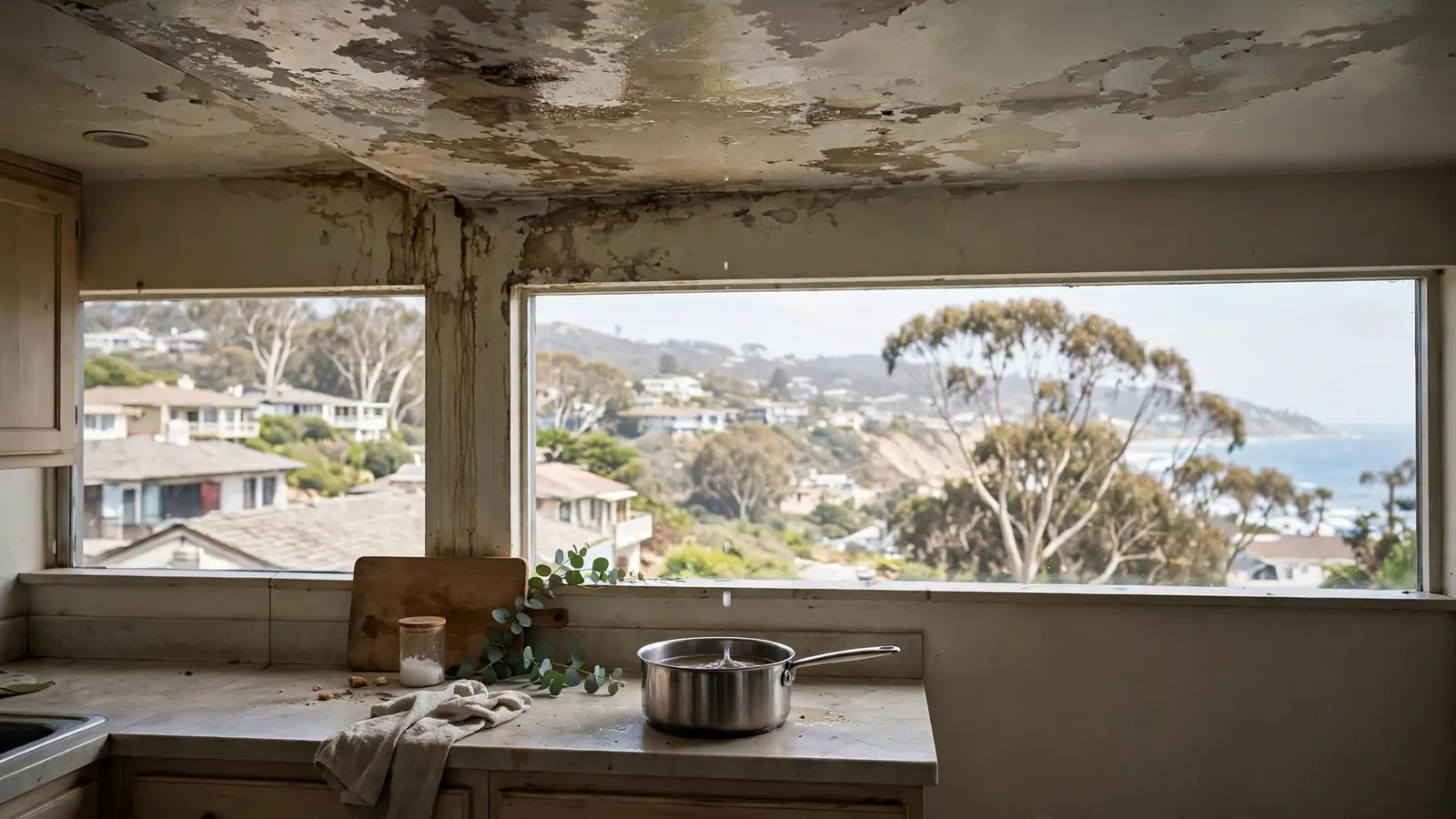
In attached housing, water does not respect property lines. A failed toilet supply in an upstairs unit leaks into the kitchen ceiling below. A washing machine overflow seeps under a shared wall into the neighbor's hallway. A blocked shared drain backs up into the lowest unit on the stack. A roof leak over one unit soaks the attic insulation over two, and the stain shows up in a third.
Each of those situations involves at least two owners, and often the homeowners association too. Each may have its own insurer. Who pays for what depends on where the water started and on the association's governing documents, usually called the CC&Rs. Meanwhile, the water keeps spreading until someone dries it.
That is why the best response in Del Mar Hills combines fast mitigation with clear communication: stop the water, get every affected unit dried, and keep separate, careful records so the owners, the HOA and the insurers can sort out responsibility afterward.
Construction
Del Mar Hills building details that affect restoration
Stacked units
Kitchens and bathrooms are often stacked one above another, sharing a riser. A leak above lands in the same room below.
Shared walls
Townhomes and side-by-side units share party walls. Water that reaches the bottom plate can wick into the neighbor's wall.
Common plumbing risers and stacks
Supply risers and drain stacks serve several units. A failure in a shared line can affect all of them.
Slab and podium construction
Ground-floor units may sit on a slab, and some buildings have parking below. Water collects at the lowest level.
Shared roofs and attics
A roof leak over one unit can spread across a shared attic to its neighbors.
Original plumbing in older complexes
Supply lines, valves and water heaters in older buildings are often original and near the end of their life.
HOA and owners
Who is responsible for what
Responsibility in a condo or townhome community is set by the CC&Rs and by California law. Most associations in the state are governed by the Davis-Stirling Common Interest Development Act, and their CC&Rs spell out which parts of the property the association maintains, usually the common areas, exterior, roof and shared systems, and which parts each owner maintains, usually the interior of the unit and fixtures that serve only that unit. [7]
In practice, the line can be blurry. A supply line that serves only one unit's toilet is usually that owner's. A shared riser inside a wall is usually the association's. A shower pan that leaks into the unit below might be the upstairs owner's responsibility, but the damage to the downstairs ceiling might be handled by the association's master policy, the downstairs owner's policy or the upstairs owner's liability coverage, depending on the documents.
You do not need to settle all of that before mitigation starts. Emergency drying protects everyone and is generally expected. Notify the HOA manager as soon as possible, tell your own insurer, and let the documentation do the work later. If you are unsure of your rights, the CC&Rs and your insurer are the places to start, and an attorney who handles community associations can help with disputes.
First steps
What to do when a leak crosses into another unit
- 1
Shut off the leak first
Shut off the fixture valve or your unit's main. If you cannot find the source, call the HOA's emergency line or management company so they can shut off the building supply.
- 2
Alert the neighbors
Knock on the doors above, below and beside you. A neighbor may not know their unit is leaking, or that yours is wet.
- 3
Tell the HOA manager
Report the leak and ask for help with access to any vacant units and to common areas such as attics and riser closets.
- 4
Document everything
Photograph and video the damage in your unit before anything moves. Ask neighbors to do the same in theirs.
- 5
Call for mitigation
Call and a contractor can assess and dry every affected unit, keeping separate records for each.
- 6
Notify your insurer
Report the loss and share the contractor's records when you have them.
By situation
Common Del Mar Hills water losses and who is usually involved
| Situation | Units affected | Usually involved |
|---|---|---|
| Toilet supply failure upstairs | Source unit and unit below | Both owners and their insurers; HOA if ceiling is a common element |
| Shower pan leak | Unit below, sometimes beside | Upstairs owner for the pan; downstairs owner and HOA for damage |
| Shared drain stack backup | Lowest unit on the stack | HOA for the stack; owner for interior cleanup; sewage protocol |
| Water heater failure in a unit | Source unit and neighbors on shared walls | Unit owner; neighbors' insurers; HOA if structure affected |
| Roof leak over a shared attic | Top-floor units | HOA for roof; owners for interiors per CC&Rs |
| Riser leak inside a wall | Several stacked units | HOA for the riser; each owner for their interior |
Multi-unit drying
Drying several units at once
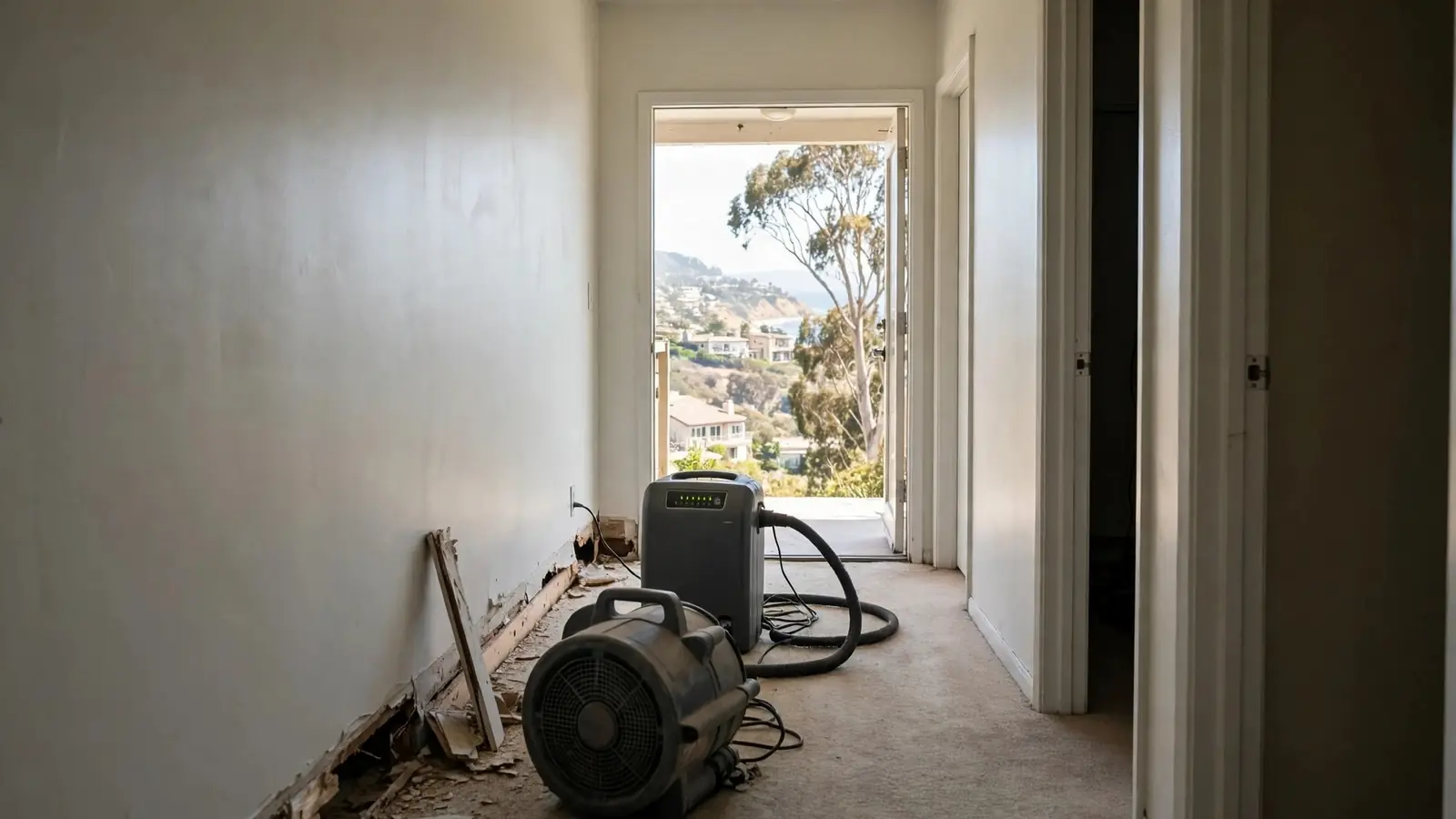
When water reaches more than one unit, the contractor treats each unit as its own job: its own moisture map, its own equipment, its own daily readings and drying log. That keeps the records clean for each owner and insurer, and it makes sure no unit is left undried because its owner was away.
Access is the usual bottleneck. Owners may be at work, traveling or renting the unit out. The HOA manager often has a way to reach owners or a right of entry for emergencies; arranging that early keeps the drying on schedule.
Shared walls and ceilings need attention from both sides. Readings in both units show where the water went, and equipment may need to run in both to dry a party wall or the floor-ceiling assembly between two homes.
- Separate moisture maps and logs per unit
- Early access through the HOA
- Drying both sides of shared walls
Drying
Drying conditions in hillside communities
The Del Mar Hills communities sit above the beach, but the coastal marine layer still reaches them much of the year, and outdoor air is often damp in the mornings. Contractors usually dry with doors and windows closed and dehumidifiers controlling the air in each unit. In buildings with shared corridors or stairwells, containment keeps humid air in the drying zone.
Equipment runs around the clock and makes noise, which can affect neighbors through shared walls. Many contractors can position units to reduce noise, and the HOA can help by letting neighbors know what is happening and for how long.
Rebuild
Rebuild and HOA approvals
After drying, repairs inside a unit, such as drywall, paint, flooring and cabinets, are usually arranged by the owner. Repairs to common elements, such as the roof, exterior walls, shared pipes and sometimes ceilings and floor structures between units, are usually arranged by the HOA. Many associations require approval for changes to flooring, especially hard floors in upper units, because of noise rules, so check before choosing new flooring.
Coordinate the schedule with the HOA and neighbors. If an association contractor is repairing a shared pipe in your wall, your own drywall repair waits until that is done.
Insurance
Insurance in Del Mar Hills
Condo owners in California usually carry an HO-6 unit policy, which covers the interior of the unit, personal property and liability, while the HOA carries a master policy for the building and common areas. The master policy may have a large deductible, and the CC&Rs may say how that deductible is shared when a loss starts in a unit. Townhome owners may have different arrangements depending on whether the association insures the structures.
Notify your insurer promptly and give them the contractor's documentation for your unit. If another owner's leak damaged your home, your insurer may pursue their insurer after paying your claim. The California Department of Insurance offers consumer help if a claim stalls. [3]
Prevention
Lowering the risk in a Del Mar Hills home
- 1
Know your shut-off and the building's
Find your unit's main valve and learn how to reach the HOA's emergency contact.
- 2
Replace supply lines on schedule
Toilet, faucet, dishwasher and washer lines in older units should be replaced every several years.
- 3
Add leak sensors
Sensors under sinks, behind toilets and near the water heater warn you and protect your neighbors.
- 4
Check the unit's water heater
Older tanks in closets and garages are a common source of multi-unit losses.
- 5
Shut off water when away
If you will be away for a long time, close your unit's main valve if the CC&Rs allow.
Related problems
Problems that follow multi-unit water damage
Mold between floors
Water trapped in the floor-ceiling assembly between units grows mold out of sight.
Disputes over responsibility
Unclear records lead to arguments between owners, the HOA and insurers.
Repeat stack backups
A shared drain with roots or buildup will block again until it is repaired.
Noise and access complaints
Long drying jobs in shared buildings test neighbors' patience; communication helps.
Rentals
Rented units and absent owners
Many units in hillside condo communities are rented out, and some owners live elsewhere. When a leak starts in a rented unit, the tenant may not know who to call, and the owner may be hours or states away. Tenants should know where the shut-off is and have both the owner's and the HOA's emergency contacts. Owners should make sure the management company can authorise emergency mitigation if they cannot be reached.
A tenant's belongings are usually covered by their own renters policy, not the owner's. Tenants should document their damaged contents separately and notify their insurer. The building and unit interior follow the owner's and the association's arrangements.
Exterior openings
Balconies, patios and sliding doors
Most units in these communities have a balcony or patio with a sliding door. Balconies above other units rely on waterproofing and drains, just like decks on detached homes, and a failure leaks into the unit below. Patio sliders on ground-floor units can take water from runoff when landscaping or walkways drain toward the door.
Balcony waterproofing is often a common element maintained by the HOA, even though each owner uses their own balcony. If you see a stain on the ceiling below a balcony, report it to the HOA as well as your insurer. Sliding door tracks should be kept clear of dirt and leaves so their weep holes can drain.
Lower levels
Garages and parking beneath buildings
Some condo buildings have parking garages or storage below the living units. Those spaces collect water from leaks above, from ramps during heavy rain and from failed sump pumps. Storage lockers and parked cars can be damaged, and electrical rooms and elevator pits are often located there. The HOA usually handles cleanup in common garages; owners handle their stored belongings. Report water in a garage immediately, because it can reach electrical equipment that serves the whole building.
On the call
What to tell the contractor about a Del Mar Hills loss
Your unit and the units affected
Which floor you are on and which neighbors may be wet.
Whether the source is stopped
And who shut it off: you, a neighbor or the HOA.
The HOA or management contact
So the contractor can coordinate access to common areas and other units.
Whether the water came up a drain
That signals a shared stack backup and sewage cleanup.
Older buildings
Older complexes and original materials
Some communities in the hills date from the 1970s and 1980s. In units of that age, popcorn ceilings, drywall joint compound and some flooring may contain asbestos, and paint applied before 1978 may contain lead. [5] Because condo ceilings are often the first thing opened after a leak from above, ask the contractor to test before cutting. In a shared building, the HOA may also need to know, since dust can travel through common corridors and ventilation. Testing usually takes little time and keeps everyone in the building safer.
FAQ
Del Mar Hills water damage questions
Does this line cover Del Mar Hills condos and townhomes?
Yes. Calls from condo, townhome and attached-home communities in ZIP 92014 can be connected to an independent restoration contractor.
Water is coming from the unit above and nobody answers. What do I do?
Call the HOA's emergency line or management company. They can usually shut off the building supply or arrange entry. Protect your belongings and document the damage.
Who pays when my neighbor's leak damages my unit?
It depends on the cause, the CC&Rs and the policies. Notify your insurer; they may recover from the responsible party's insurer.
Do I need HOA approval for emergency drying?
Emergency mitigation in your unit should not wait. Tell the HOA promptly, especially if shared pipes, walls or ceilings are involved.
Can one contractor dry several units?
Yes, as long as access is arranged. Separate records for each unit help every owner and insurer.
What is the HOA usually responsible for?
Typically the roof, exterior, common areas and shared systems such as risers and stacks. Your CC&Rs are the final word.
Is a backup from a shared drain sewage?
Yes. Water coming back up through a drain is treated as Category 3 and needs sewage cleanup.
Should I wait for the HOA's own contractor?
Some associations have a preferred vendor for common elements. Inside your unit, emergency drying should start promptly; ask the HOA manager whether their vendor is already on the way, and tell your insurer what was done and by whom.
My ceiling was opened. Who closes it?
That depends on whether the ceiling is part of your unit or a common element under the CC&Rs. Ask the HOA manager before scheduling repairs, so the right party arranges them.
Will the equipment noise bother my neighbors?
It can, through shared walls. Let them know how long it will run, and ask the contractor about placing units to reduce noise.
How long does drying take in a condo?
Usually three to five days per affected unit, longer if water collected between floors or in a slab.
Sources and citations
- [1]IICRC S500 Standard for Professional Water Damage Restoration
- [2]EPA: A brief guide to mold, moisture and your home
- [3]California Department of Insurance
- [4]Contractors State License Board (CSLB)
- [5]EPA: Protect your family from exposures to asbestos
- [6]EPA: Renovation, Repair and Painting Program
- [7]California Civil Code: Davis-Stirling Common Interest Development Act