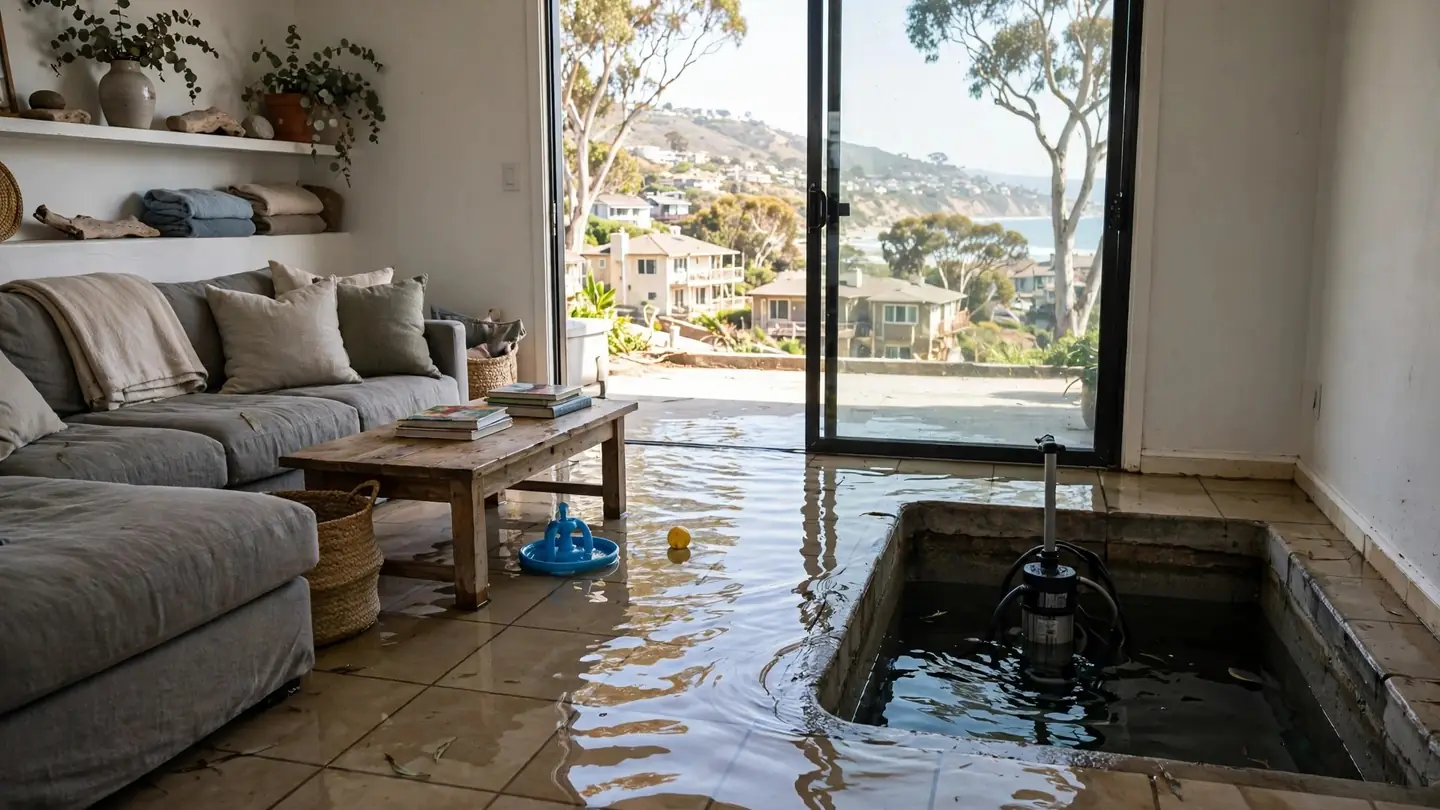
Key facts: Basement and lower-level flooding
- Below-grade rooms flood from seepage through walls, runoff through doors, failed sump pumps and drain backups.
- Water that comes up through a floor drain is treated as sewage-contaminated.
- Outside flood water is usually excluded from standard homeowners policies and needs separate flood cover.
- EPA guidance recommends drying wet materials within 24 to 48 hours.
Entry points
How water gets into lower levels
Seepage through uphill walls
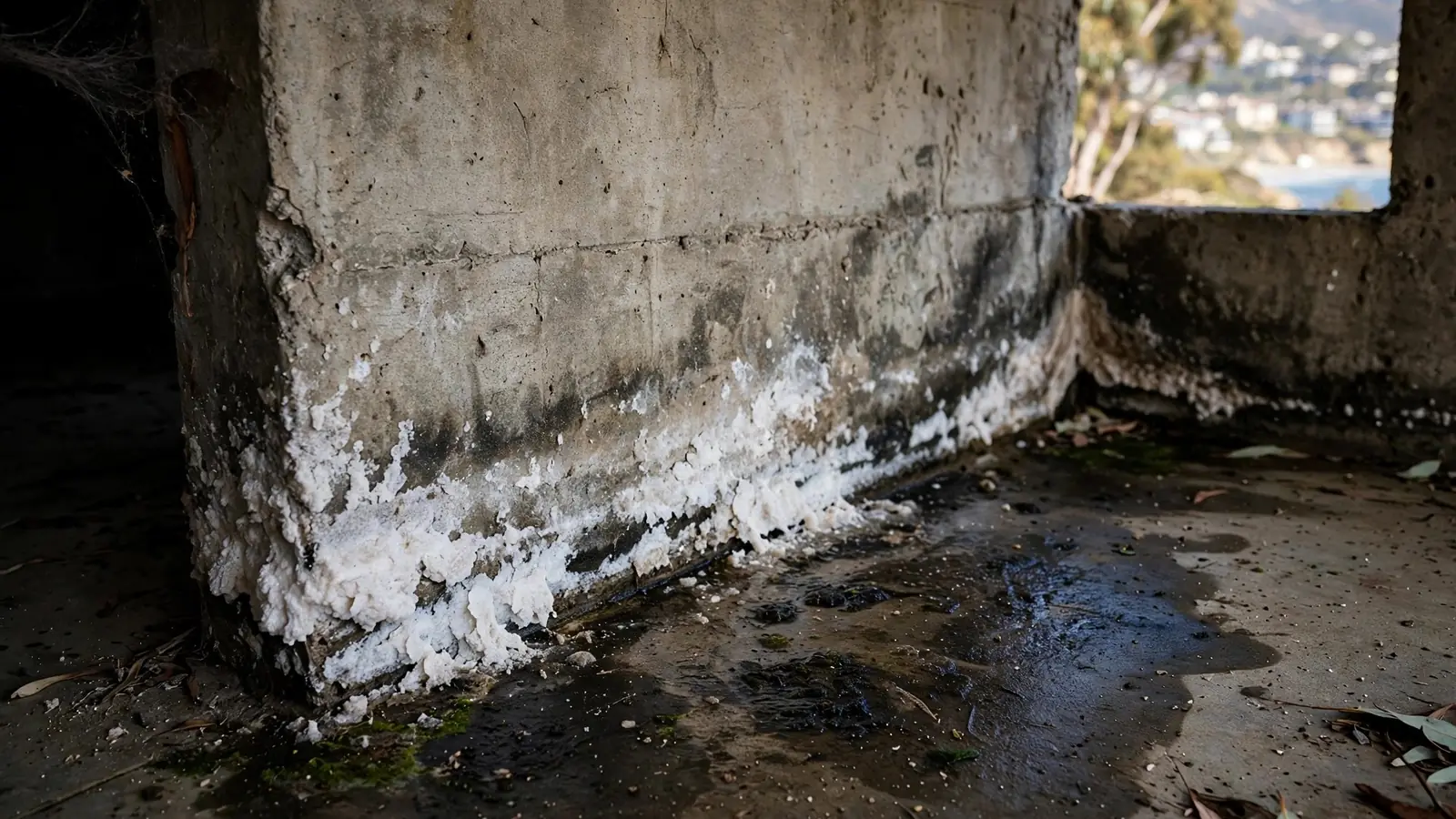
A wall holding back soil carries water pressure after rain. Water seeps through cracks, joints and the wall-floor joint.
Runoff through doors
Driveways and stairs that slope down to a garage or lower door send storm water straight at the threshold.
Sump pump failure
Homes with a sump depend on it during storms. A failed pump, a tripped breaker or a power cut lets the pit overflow.
Floor drain backups
When the sewer surcharges in heavy rain, the lowest drain in the house becomes the outlet.
Window wells
Window wells without drains fill with water and leak through the window.
Plumbing inside
Water heaters, laundry and wet bars on lower levels fail just like anywhere else, but the water has nowhere to go.
Local context
Why Del Mar lower levels are at risk
Del Mar's terrain does most of the work. On the hills of Olde Del Mar, Del Mar Terrace and the canyon edges, houses step down slopes and their lower rooms sit against soil that fills with water in winter storms. On the flat ground near the river mouth, the risk is the reverse: ground floors and garages only a few feet above sea level, where the river, the street or the ocean can push water inside.
Most of the year's rain falls in a few storms, sometimes as atmospheric rivers that drop a lot of water in a day or two. [3] Drains, sump pumps and grading that are fine for an ordinary shower can be overwhelmed. That is when lower-level calls spike.
Right away
What to do when a lower level floods
- 1
Stay safe
Do not walk into water above outlet height, or anywhere power may be live. Turn off power at the panel if you can reach it safely, or wait for help.
- 2
Find the source
Is the water coming through a wall, a door, a drain or a pipe? If a drain, stop using water in the house.
- 3
Check the sump
If you have one, check that it is running and the discharge is clear. A battery backup helps during power cuts.
- 4
Document
Photograph the water level, the entry point and damaged belongings.
- 5
Move belongings up
Carry what you can to a higher floor.
- 6
Call
A restoration contractor can extract the water, assess contamination and set up drying.
Sources
Lower-level water sources and what they mean
| Source | Contamination | Typical cleanup |
|---|---|---|
| Pipe or water heater leak | Clean at first | Extraction; dry in place where possible |
| Seepage through a wall | Usually clean but mineral-laden | Dry the room; fix drainage outside |
| Runoff through a door | Contaminated | Remove soaked porous materials; disinfect |
| Floor drain backup | Sewage | Full sewage cleanup with containment |
| River, street or ocean flood | Contaminated | Flood cleanup; remove porous materials |
Garages
Garages below the street
Garages are the most common flooded lower space in Del Mar. Many sit at the bottom of a driveway, and some share a wall with a bedroom, laundry or family room. Water that comes under the garage door spreads across the slab, soaks stored boxes and runs under the shared wall into the house. Garage water heaters and washers add an inside source.
Cleanup in the garage itself is usually straightforward: extract, clean and disinfect the slab and lower walls if the water was dirty, and sort stored items. The shared wall needs readings on the house side, because that is where damage hides. A trench drain at the garage door works only if it is kept clear of leaves and sand.
Drying
How a flooded lower level is dried
Below-grade rooms are the slowest in the house to dry. The walls against soil are cool and often damp from the outside, the slab holds water, and air does not move much. Contractors remove wet carpet and pad, cut drywall above the wet line if the water was contaminated or the drywall is soft, and run dehumidifiers and air movers until readings reach the dry goal.
A wall that keeps getting wet from outside will not reach a dry goal until the outside problem is fixed. If readings on an uphill wall stall, the contractor should say so, and a drainage or waterproofing contractor should look at it before the wall is closed up again.
Prevention
Protecting a lower level for next winter
Outside, clear driveway and stair drains, gutters and downspouts before the rainy season, and make sure downspouts discharge away from the house. Check retaining wall weep holes and window well drains. Keep sandbags or a door barrier on hand if your garage or lower door sits below the street.
Inside, test the sump pump by pouring water into the pit, and think about a battery backup and a high-water alarm. Ask a plumber about a backwater valve if a lower drain has ever backed up. Keep stored items on shelves rather than the floor, and choose tile or sealed concrete over carpet for lower rooms.
If you live in a mapped flood zone near the river, check FEMA's flood map and your flood insurance. [4] Lower levels are usually where flood damage is worst.
FAQ
Lower-level flooding questions
My lower level only gets wet in heavy rain. Why?
Usually groundwater pressure on an uphill wall, runoff at a door, or a drain that backs up when the sewer is full. The timing points outside.
Is seepage through a wall covered by insurance?
Often not, because it is treated as groundwater or maintenance. Sudden internal leaks are more often covered. Check your policy.
Can carpet in a lower room be saved?
After a clean-water leak caught quickly, sometimes. After runoff, a drain backup or flood water, usually not.
Do I need a sump pump?
If water regularly collects under or in a lower floor, a drainage contractor may recommend one, ideally with a backup.