
Key facts: Del Mar Terrace
- Del Mar Terrace is a hillside neighborhood within the 92014 ZIP code.
- Wind-driven rain during coastal storms can force water past window and door seals that stay dry in normal rain.
- On multi-level homes, water from an upper-floor leak typically travels down through framing and can damage every level below.
- EPA guidance recommends drying wet materials within 24 to 48 hours to prevent mold growth.
Covered area
Del Mar Terrace streets covered by this line
Calls from Del Mar Terrace homes can be connected to an independent restoration contractor.
- 92014Del Mar Terrace's hillside streets and the stepped lots around them within ZIP 92014.
About Del Mar Terrace
Why water behaves differently on Del Mar Terrace lots
The name says a lot. Del Mar Terrace is built on a hillside where lots are cut into steps, and homes are designed to fit them: a garage and entry at the street, living space on one or two levels below or above, and decks and terraces stepping down toward the view. Many houses have walls of glass facing west, with large sliding or folding doors opening onto decks.
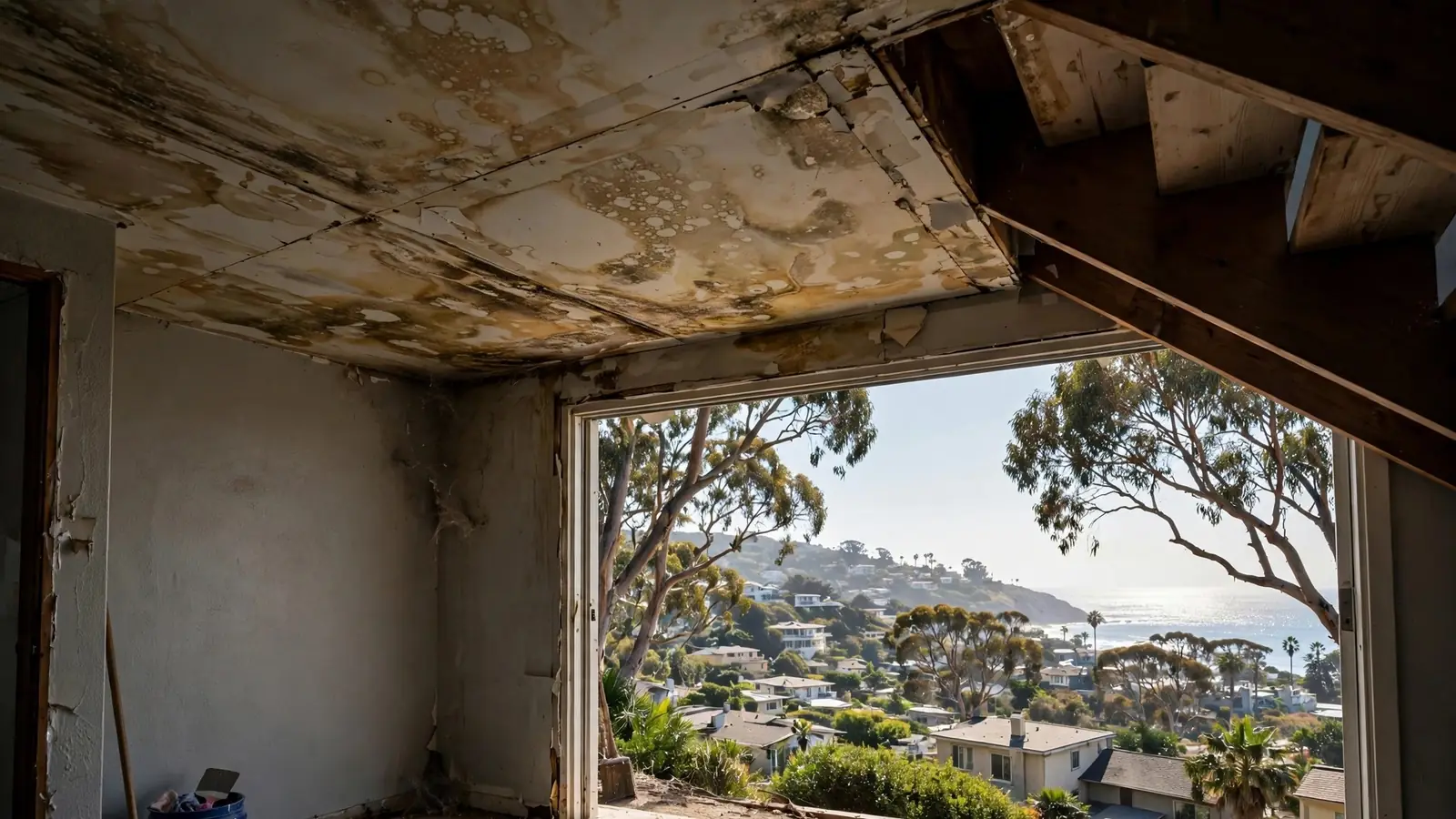
That layout means water has a long way to travel inside the house. A supply line that fails on the top floor does not just wet one room. Water runs through the floor, along joists and down wall cavities, and may show up two floors below as a dripping light fixture or a stain on a ceiling. Every level in between may be wet inside the walls even if the surfaces look dry.
Outside, the stepped yard and the slope above the house shape where rain goes. Terraced planting beds, retaining walls, patios and stairs all collect and redirect water. When drains in those features clog, or when grading tips toward the house, heavy rain ends up against walls and under doors.
And the views come with exposure. The west-facing glass that makes these homes special also takes the brunt of winter storms blowing off the ocean, and wind-driven rain can find its way past seals and thresholds that never leak in calm weather.
Construction
Del Mar Terrace construction details that affect restoration
Multi-level framing
Floors stack over each other with stairs between. Water from above travels down through framing to every level below.
Large view windows and sliders
Big glass openings and multi-panel doors have long seals and thresholds. Wind-driven rain tests every inch of them.
Decks over living space
Upper decks often sit over bedrooms or family rooms. A failed membrane leaks into the ceiling below.
Retaining walls on terraced lots
Walls hold back soil at each step. Their drains must flow, or water builds up and pushes toward the house.
Raised floors on the downhill side
The lowest level may sit on a raised floor over a crawlspace on the slope, where water and humidity collect.
Exterior stairs and landings
Outdoor stairs and landings that slope toward doors send rain straight at thresholds.

Storm leaks
Wind-driven rain and west-facing glass
Winter storms on the San Diego coast often come with strong onshore winds, and some arrive as atmospheric rivers carrying heavy rain. [2] When wind drives rain sideways against a wall of glass, water is pushed into every gap: the bottom track of a sliding door, the corners of a window frame, the joints between panels of a folding door, and the flashing around them. A door that has never leaked before can leak badly in one storm, and then stay dry for the rest of the winter.
The water usually shows up at the floor just inside the opening, but that is not where the damage ends. It runs under the bottom plate into the wall on either side, soaks the subfloor or the edge of the slab, and can drip through to the level below. On upper floors, it may appear first as a ceiling stain in the room beneath.
Restoration starts with drying the wall cavities beside the opening and the floor just inside it, and checking the room below. Then a window or door specialist should check the seals, the sill pan and the weep holes in the track, which often clog with sand and debris near the coast.
Assessment
What a contractor should check in a Del Mar Terrace home
- 1
Trace the water down through the levels
Take readings on every floor below the source, including inside closets, stairwells and ceilings.
- 2
Check openings on the weather side
Inspect sliders, folding doors and big windows for water at the sill, wet wall cavities beside them and stains below.
- 3
Look under decks
Check ceilings below upper decks and terraces for stains, sagging or damp readings.
- 4
Inspect the crawlspace
On raised lower floors, check under the house for water, wet insulation and a damaged vapor barrier.
- 5
Check the yard drainage
Note clogged drains, retaining wall weep holes and grading that tips toward the house.
- 6
Plan access on steps and stairs
Equipment may have to be carried down stairs or exterior paths; the contractor should plan safe routes.
What you might see
Del Mar Terrace water damage clues and causes
| What you notice | Likely cause | What to do |
|---|---|---|
| Water at the base of a slider after a storm | Wind-driven rain past the track or sill | Dry the floor and walls beside it; have the door serviced |
| Drip from a light fixture on a lower floor | Leak on the floor above traveling down | Find the source; drain and dry the ceiling cavity |
| Stain on a bedroom ceiling below a deck | Failed deck membrane or blocked deck drain | Repair the deck; dry the ceiling and framing |
| Damp, musty lower level | Crawlspace moisture or wall seepage | Inspect underneath; dry and improve drainage |
| Water along a wall next to a terraced bed | Planter drainage or irrigation against the wall | Fix drainage; dry the wall cavity |
| Swollen stair treads inside | Water running down the stairs from above | Lift carpet; dry treads and stringers |
Multi-level leaks
Leaks that start upstairs and end downstairs
In a house with three levels, a single failed toilet supply on the top floor can damage all three. Water spreads on the floor where it starts, finds a path through the subfloor at a seam or penetration, collects on the ceiling below and spills down again at the next opening.
The visible damage on each floor is usually smaller than the real damage inside walls and between floors. Contractors map each level with meters and thermal imaging, then open ceilings where water has pooled and dry the floor and ceiling assemblies from both sides.
If you find a leak on an upper floor, shut off the water and check the rooms below right away, even if they look fine. The sooner the lower levels are dried, the less has to be removed.
- Shut off the water and check every level below
- Do not stand under a bulging ceiling
- Ask for readings on each floor
Drainage
Terraced yards, planters and drainage
Terraced gardens make the most of a steep lot, but they create many places for water to collect. Raised planters built against the house can soak the wall behind them, especially if irrigation runs often. Retaining walls at each step need open weep holes or a drain behind them, or the soil behind them fills with water. Patios and landings that slope toward the house send water to the door.
After a storm, walk the property: look for standing water against walls, drains that did not empty, weep holes that are blocked, and mud or debris washed against the house. Clearing these is the first step; a drainage contractor can add or repair drains, regrade patios and move planters away from walls.
Inside, dampness along a wall next to a planter, or in a lower room behind a retaining wall, often points to the yard rather than the plumbing. The room can be dried, but the dampness will come back until the drainage is fixed.
Under the house
Raised lower floors and crawlspaces
On the downhill side, many Terrace homes have a lowest floor raised on posts or a short foundation wall, with a crawlspace on the slope below. Water from leaks above, from wind-driven rain or from runoff can collect there. Because crawlspaces are rarely visited, a problem can go unnoticed until a musty smell rises into the house or floors start to soften.
Drying a crawlspace usually means removing wet insulation and a wet or torn vapor barrier, pumping any standing water, and running a dehumidifier under the house until the framing reaches its dry goal. A new vapor barrier goes down once the soil surface is dry. The rooms above may need drying at the same time.
Drying
Drying multi-level homes near the coast
Drying a house with several levels means treating each level as its own drying zone, with equipment and readings on each. Water that collected in a floor or ceiling assembly between levels needs air from both sides, which may mean opening a ceiling below. Stairwells move air between floors, so containment or closed doors can help each zone dry faster.
Humidity matters on the coast. Morning marine layer can keep outdoor air damp for days in late spring and early summer, so drying is usually done with the house closed and dehumidifiers controlling the air. On dry days with offshore winds, outdoor air may be useful; the readings decide.
Rebuild
Repairs and rebuilding on Terrace lots
Once the house is dry, the repair list often includes trades besides drywall and paint: a window and door specialist for leaking sliders, a deck or waterproofing contractor for a failed membrane, a drainage contractor for the yard. Fixing the cause before closing walls prevents a repeat in the next storm.
Work on slopes, retaining walls and grading can need permits and engineering. Ask the relevant city building department before you start structural or grading work. When replacing finishes, water-tolerant materials near large openings and on lower levels make future leaks easier to recover from.
Insurance
Insurance for Del Mar Terrace water damage
Sudden internal leaks are usually homeowners claims. Wind-driven rain is a common grey area: some policies cover rain damage only if wind first created an opening, such as a broken window, while others treat seal failures as maintenance. Long-term deck leaks may be excluded as gradual damage. Surface runoff from a storm is often treated as flood.
Photos of the storm conditions, the water entry point and each affected level, plus the contractor's readings and drying log, make these claims clearer. The California Department of Insurance has consumer guidance if a claim stalls. [5]
Prevention
Preparing a Del Mar Terrace home for winter storms
- 1
Clean door tracks and weep holes
Sand and debris in sliding door tracks block the weep holes that let water out.
- 2
Check seals on the weather side
Look at caulking and gaskets on west-facing windows and doors before the rainy season.
- 3
Clear deck and patio drains
Make sure every drain on decks, terraces and landings is flowing.
- 4
Open retaining wall weep holes
Clear blocked weep holes and drain outlets at each terrace step.
- 5
Look under the house
Check the crawlspace once a year for water, damage and pests.
Related problems
Problems that follow water damage in hillside homes
Mold inside floor assemblies
Water trapped in floor and ceiling assemblies grows mold where no one can see it.
Rot at door and window framing
Repeated wind-driven leaks rot sills, jambs and the framing beside large openings.
Soft subfloors
Subfloor near leaking sliders and toilets softens and may need replacement.
Crawlspace moisture
Damp crawlspaces feed mold, rot and pests and send musty air into the house.
Inside the house
Stairwells, landings and open floor plans
Multi-level homes in the Terrace often have open stairwells, double-height living rooms and landings that join one level to the next. Those features move water as well as air. A leak on an upper landing can run down the stair stringers and soak every tread; water that reaches an open floor plan spreads across a wide area because nothing stops it.
Carpeted stairs need the carpet and pad lifted so the treads and stringers can dry. Hardwood stairs are dried in place where possible. In double-height rooms, high walls may be wet at the top from a leak above and dry at the bottom, which is the reverse of most leaks, so readings need to be taken at several heights.
Above the top floor
Skylights, clerestories and roof decks
Homes designed for light and views often add skylights, clerestory windows and rooftop decks. Each one is an opening in the roof with flashing that has to stay sound in salty, windy weather. A skylight leak usually shows as a drip or stain at the skylight well, but water may also run along the roof framing and come down in a wall. Roof decks over living space behave like any other deck: a membrane failure leaks into the room below. Check these openings every fall and after big storms, and have damaged flashing repaired before the next rain.
On the call
What to tell the contractor about your Terrace home
How many levels the house has
And which level the water started on, if you know.
Whether it was raining hard
Storm timing points toward windows, doors and decks rather than plumbing.
How to reach each level
Interior stairs only, or exterior paths and stairs too. Mention steep or narrow access.
Whether there is a crawlspace
And when it was last checked.
Outdoor water
Pools, spas and water features on terraces
Some Terrace homes have pools, spas or fountains built into the terraces. Their plumbing, overflow lines and backwash discharge all add water to a hillside lot. A leaking pool line or a spa overflow that drains toward the house can soak a retaining wall or a lower-level wall for weeks, and because it is not storm-related, it is often blamed on something else.
If a lower-level wall is damp in dry weather, check the pool and spa equipment and lines, and make sure backwash and overflow water discharge where they are supposed to. A pool leak detection service can test the system. The room itself is dried in the usual way once the source is fixed.
FAQ
Del Mar Terrace water damage questions
Does this line cover Del Mar Terrace?
Yes. Calls from Del Mar Terrace homes in ZIP 92014 can be connected to an independent restoration contractor.
Why does my slider only leak in big storms?
Strong wind pushes rain into the track and seals with more force than normal rain. Blocked weep holes or worn seals let it through.
Water came through my downstairs ceiling. Where did it start?
Usually on the floor above, in a bathroom, laundry, kitchen or at a deck or window. The contractor traces it with meters.
Do all levels need drying if only one looks wet?
Often yes. Water travels down inside walls and between floors. Readings on each level show what needs drying.
Can a deck leak cause mold in the room below?
Yes. Slow leaks keep the ceiling and framing damp for months, which is ideal for mold.
Is wind-driven rain covered by insurance?
It depends on the policy and how the water got in. Document the storm and the entry point and ask your insurer.
My lower level smells musty. What should I check?
The crawlspace, the walls behind any retaining wall or planter, and the ceiling under any deck.
Will the contractor need to open my ceilings?
Only where water has pooled inside a floor or ceiling assembly and cannot dry another way. Readings show where that is, and the openings are kept as small as the drying allows.
Should I tarp a leaking window from outside?
Only if it is safe to reach without ladders on wet slopes. Inside, towels at the sill and a bucket help until the storm passes.
How long does drying take in a multi-level home?
Usually three to five days per affected level, sometimes longer where water collected between floors.
Sources and citations
- [1]Coastal Commission: City of Del Mar Local Coastal Program sea level rise grant application
- [2]NOAA: What are atmospheric rivers?
- [3]IICRC S500 Standard for Professional Water Damage Restoration
- [4]EPA: A brief guide to mold, moisture and your home
- [5]California Department of Insurance
- [6]EPA: Protect your family from exposures to asbestos
- [7]EPA: Renovation, Repair and Painting Program
- [8]Contractors State License Board (CSLB)
- [9]Wikipedia: Del Mar, California